
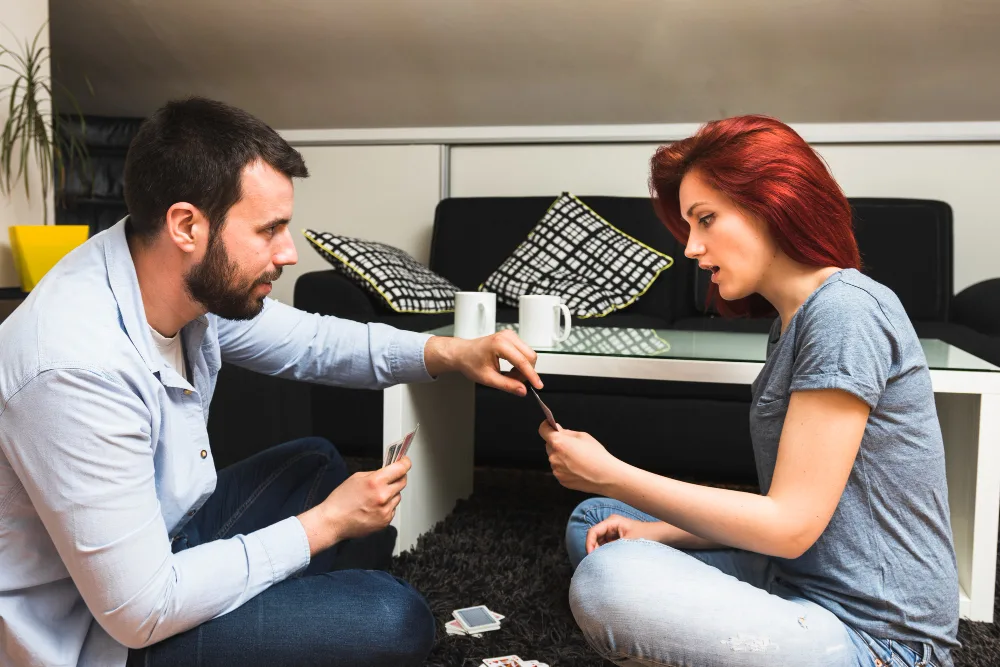
A couple I worked with had the same fight for eleven years. She would describe a bad day at work. Within ninety seconds he would be telling her what to say to her manager. She would get angry. He would then get hurt, because he had been trying to help, which was perfectly true. Neither of them was wrong about their own intentions, and both of them were exhausted. What they were missing is the thing this article is about. Active listening in relationships is a skill with actual steps, and almost nobody is taught it.
So let me be clear about what it is and why the urge to fix runs so deep. Then I will give you the techniques in the order I usually teach them.
What active listening in relationships actually means
Most people think listening means staying quiet while the other person talks. It does not. Staying quiet while you compose your rebuttal is not listening, and your partner can tell.
Active listening means three things happening at once. You take in what they are saying. You work out what it means to them, which is often different from what the words say. Then you show them you have got it, out loud, before you say anything of your own.
That last part is what people skip, and it is the part that does the work. An unspoken understanding does not land. Your partner needs the evidence.
The research is unambiguous about why this matters. Harvard’s summary of the health benefits of strong relationships puts feeling understood near the centre of what makes a partnership protective rather than draining.
Why active listening in relationships is so hard
The urge to jump in is not rudeness. It is usually one of three things, and knowing which one is yours helps.
Some of us fix. Distress in someone we love registers as a problem. A problem demands a solution, so we hand over advice nobody asked for. Others defend. A complaint sounds like an accusation, so we start explaining ourselves before the sentence has finished. And some of us simply cannot stay still inside another person’s feelings, because our own nervous system starts reacting to theirs.
The third one is worth naming properly. If your body tightens the moment your partner gets upset, no technique will hold. Co-regulation explains what is happening, and nervous system regulation gives you something to do about it before the conversation starts.
Seven techniques for active listening in relationships
Work through these in order. The later ones assume the earlier ones are in place.
1. Put the phone somewhere else
Not face down. In another room. Partial attention is worse than a postponed conversation, because it teaches your partner that they rank somewhere below a notification.
If now is genuinely impossible, say so and name a time. I want to hear this properly and I have ten minutes before the call. Can we do it at eight? That is not a rejection. That is a promise, provided you keep it.
2. Reflect back before you respond
This is the technique at the centre of active listening in relationships, and it feels unnatural for about a fortnight.
When they finish, say what you heard in your own words. So the meeting was bad, and what is really getting you is that nobody backed you up afterwards. Then ask whether you got it right. Sometimes you will be wrong, which is precisely the point: you found out cheaply instead of arguing for an hour about a misunderstanding. Active listening exercises has structured practice for this if you want to drill it properly.
3. Listen for the feeling under the story
People rarely lead with the real thing. They lead with the logistics of the real thing.
A complaint about the bins is sometimes about the bins. More often it is about carrying too much alone. Your job is to hear the second one without dismissing the first. You do that by naming it gently and letting them correct you. Bids for connection describes how many of these small approaches a couple makes in a day, and how much rides on noticing them.
4. Validate before you disagree
Validation gets confused with agreement, and they are not the same thing at all. You can think your partner has read a situation completely wrong and still say I can see why that landed the way it did.
Do the validating first, always. A person who feels understood can hear a different view. A person who feels dismissed will defend their position for as long as it takes. You both end up somewhere neither of you meant to go. Holding space is the fuller version of this posture.
5. Ask open questions and then be quiet
How did that feel? What is the part that is still bothering you? Is there more?
That last one is the most useful question I know. Most people stop at the socially acceptable version of what they wanted to say. Is there more opens the door to the rest of it. Then stop talking. A silence of four or five seconds is not awkward. It is an invitation. People fill it with the thing they were not sure they were allowed to say.
6. Say what you appreciate about the telling
If your partner takes a risk and it goes well, say so. That cannot have been easy to bring up, and I am glad you did.
This sounds like flattery and it is closer to maintenance. The Gottman Institute’s work on turning toward instead of away shows that couples build their reserves in exactly these small moments, not in the big conversations. Vulnerability in relationships explains why the response to an opening matters more than the opening itself.
7. Take your turn properly afterwards
Active listening in relationships is not a vow of silence. Once your partner feels heard, you get to speak. You will find they listen far better than they would have ten minutes earlier.
Say your part in the first person rather than as a verdict on them. I-statements covers the wording, and how to communicate your needs effectively deals with what to do when the thing you need is hard to say.
Three mistakes that ruin active listening in relationships
Most attempts at this fail in one of three predictable ways.
Advice nobody requested. If you are unsure, ask outright: do you want ideas, or do you want me to listen? The question is not a cop-out. It is the single most useful sentence in this entire article.
Parroting instead of understanding. Reflecting back becomes a technique performed at someone when the words are right and the attention is elsewhere. People can always tell, and it is more insulting than not trying.
Listening only when it is calm. Anyone can do this on a Sunday afternoon. The test is whether you can do a version of it during a disagreement. That is what fair fighting rules are built for. Repair attempts pick up when it has already gone wrong.
When one of you shuts down instead
Sometimes the problem is not technique. One partner goes silent, blank, unreachable, and the other keeps pressing.
That is usually flooding rather than indifference. A body past its limit cannot process language well, and pushing harder makes it worse for both of you. The move is a break with a time attached, and stonewalling in relationships sets out how to do that without it feeling like abandonment. Psychology Today has a good overview of the same pattern from the other side.
A three-question journal for this week
Five minutes, alone, in writing:
- When my partner last told me something difficult, what did I do in the first thirty seconds?
- Which of the three urges is mine: fixing, defending, or getting overwhelmed?
- What is one conversation this week where I could ask do you want ideas, or do you want me to listen?
The third answer is the one to act on.
When it is more than a listening problem
Some silences are not about skill. Perhaps one of you cannot raise anything without it becoming a fight. Perhaps contempt has crept into how you speak to each other, or you have both stopped bothering to try. A couples counselor will get further than a technique will. And if any of this has left you thinking you would rather not be here, please call or text 988 tonight.
Conclusion: active listening in relationships is a practice, not a personality
Active listening in relationships is not something you either have or lack. It is a set of small, slightly awkward habits. The phone in another room. The sentence that starts so what I am hearing is. Asking whether they want ideas or an ear. In my experience couples do not fix this by having one enormous honest conversation. They fix it by getting the first thirty seconds right, over and over, until being heard stops feeling like a special occasion
Check out the author’s book here: Love and Relationship Workbook for Couples

Leave a Reply